

Introduction
to the Framework
The Framework page gives the overview: the dependency structure, the layer logic, the gate criteria. This page is where each layer gets its full expression.
Every article here treats a specific structural pattern in depth — a failure mode, a misread signal, a dependency that organisations skip and pay for later. Some map directly to a CPL layer: an article on POC failure is a Layer 2 treatment; an article on scaling crises is a Layer 4 diagnostic. Others cut across layers, examining dynamics like the Founder Bottleneck or the Heroics Trap that surface differently depending on where in the dependency structure a startup or corporate innovation team is working. Where an article speaks to one track more than the other — startup or corporate — I've noted it, but most of the structural patterns apply to both. The forces are the same; the organisational terrain differs.
These are not blog posts. They're diagnostic reference material. When I'm working with a founder or a corporate innovation team, I'll often point them to a specific article as preparation for our next session. The article does the conceptual work; the session does the applied diagnostic.
Framework Overview
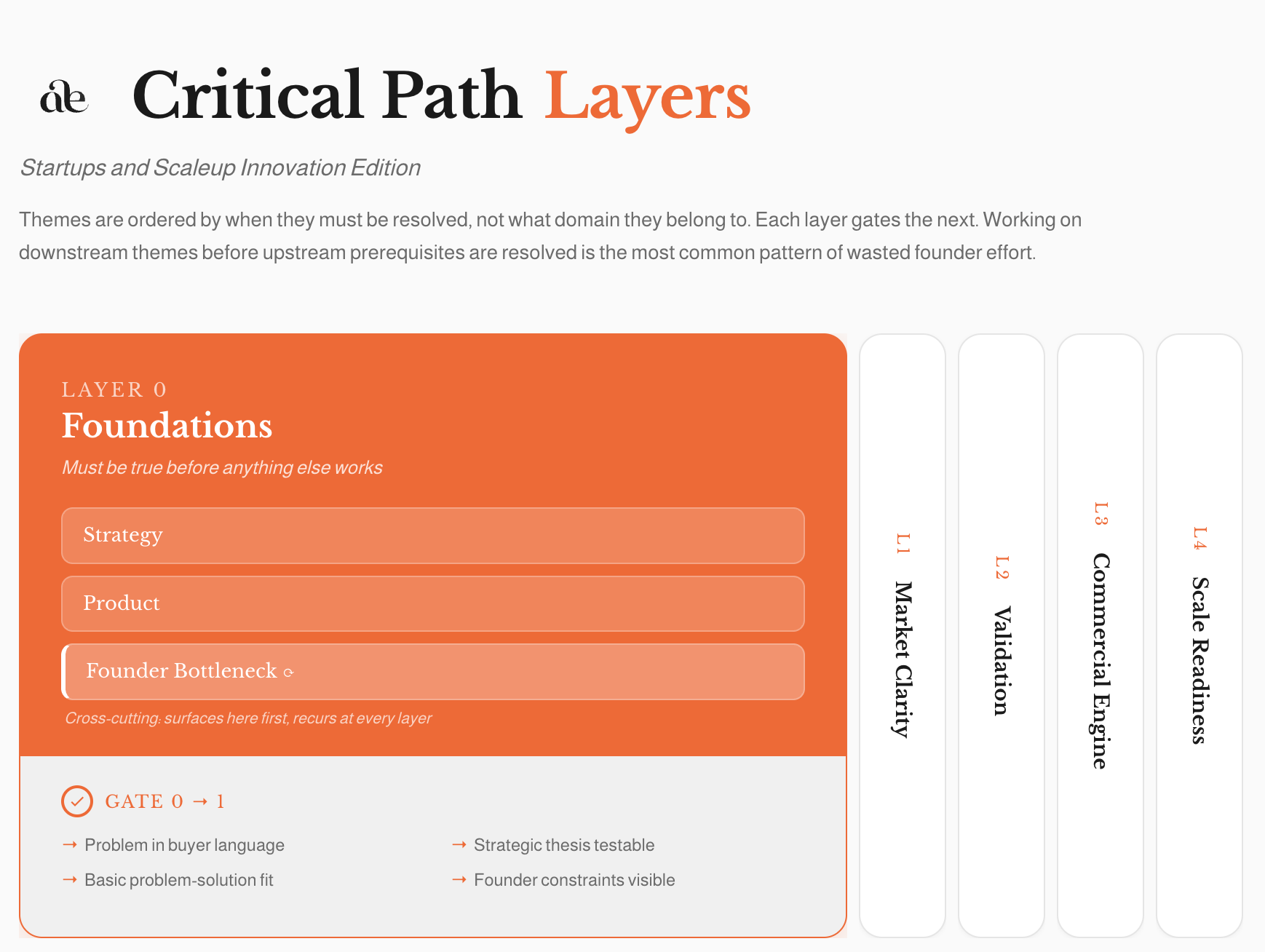
Critical Path Layers: A Dependency Map for Innovation
The full articulation of the framework: why innovation work follows a dependency structure, and what happens when you skip layers.
Contemplating the Floating of Things
Francis Bacon argued that we must obey the forces we wish to command. That sentence is the entire thesis of the Critical Path, compressed into nine words. The philosophical case for why sequencing matters — from the law of floatation to the logic of layered dependencies.
Layer-1 (Corporate Track) - Problem Classification
The layer most often skipped and most expensive to skip. Layer 0 asks whether the problem is real, the product demonstrates basic fit, and the strategic thesis is explicit — or whether everything downstream is being built on assumption.
The AI Classification Problem
Most organisations misclassify their AI initiatives: they treat transformation as optimisation because optimisation is fundable and governable. This article introduces a three-class taxonomy and a reversibility diagnostic that cuts through the frameworks (Christensen, Nagji & Tuff, Wardley) that can't classify AI correctly.
Layer 0 - Foundations / Problem Legitimacy
The layer most often skipped and most expensive to skip. Layer 0 asks whether the problem is real, the product demonstrates basic fit, and the strategic thesis is explicit — or whether everything downstream is being built on assumption.
Beyond the AI Hype: Why Corporate Innovation Starts with Organisational Plumbing
Why automating a broken process produces faster failure. The four foundations — process intelligence, data governance, organisational alignment, and leadership — that must exist before any AI or innovation initiative is meaningful.
Situational Awareness: Why Strategy Without a Map Is Guesswork
Strategy frameworks give you a thesis; Wardley Mapping gives you a position — and the difference determines whether your defensibility assumptions survive contact with an evolving market. A diagnostic case for why plotting your value chain against the evolution curve is the Layer 0 work that makes every downstream decision — ICP, pilot design, sales positioning — structurally sound rather than structurally lucky.
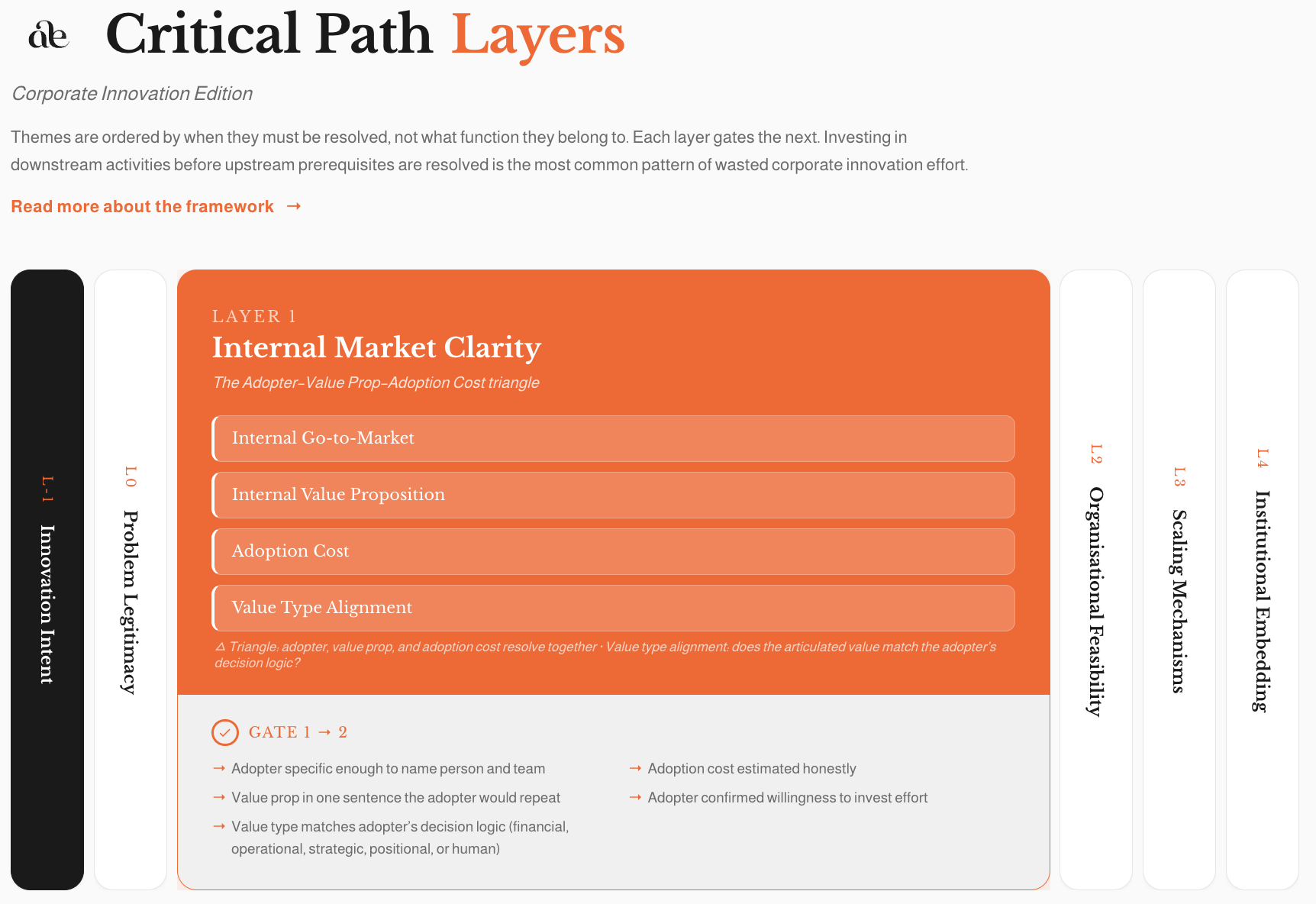
Layer 1: Market Clarity
The ICP–value proposition–pricing triangle. These three resolve together, and movement on any one forces reassessment of the other two. Most positioning failures and "pipeline not converting" problems trace back to unresolved Layer 1 dependencies.
The Growth Metrics Everyone Tracks — That Don't Actually Drive Growth
Replacing vanity metrics with measurements that track actual commercial traction at the market clarity layer.
The AI-Native Paradox
How AI is collapsing defensibility at Layer 0 and distorting market signals at Layer 1 — creating a dependency cascade that neither founders nor investors have fully reckoned with.
The AI-Native Metrics Revolution: Why Traditional SaaS Measurements Are Failing AI Startups
When ARR, churn, and unit economics stop meaning what they used to. New measurement frameworks for AI-native companies — and why the old ones are producing false confidence.
Stress test your ICP definition & ICP with our online diagnostic tools
Layer 2: Validation
The critical gate. Everything before it is hypothesis; everything after it depends on the evidence it produces. Layer 2 tests whether the solution works in context — technically, politically, and commercially.
Why Your POC Succeeded and Still Failed
The proof-of-concept that hit every technical milestone and died in procurement. A structural diagnosis of why pilots fail at the organisational layer — and why the blockers almost always sit inside the corporate partner, not with the startup.
Try our POC Lifecycle Diagnostic tool
Layer 3: Commercial Engine
Where most founders want to start — and where the Critical Path says they shouldn't, until Layers 0–2 are resolved. Pipeline development without a validated ICP is activity theatre. Content marketing amplifying an unclear value proposition is noise at scale.
Growth: Obey the Forces You Wish to Command
The Ehrenberg-Bass principles that actually govern how brands grow — mental availability, physical availability, category entry points, distinctive assets — and why most growth teams are optimising the wrong levers.
Layer 4: Scale Readiness
Scaling is not a phase that follows building. Scaling is the test of whether the building was real. Layer 4 examines whether the organisation, operations, and finances can support the growth that earlier layers unlocked — or whether everything is still load-bearing on specific people.
What Happens to Startups When They Grow Up
The four predictable scaling crises — and why each one traces back to an unresolved gate criterion at a specific layer.
Cross-cutting Dynamics
Some patterns don't sit in a single layer — they surface differently depending on where in the dependency structure you're working. The Founder Bottleneck appears at Layer 0 as an inability to articulate the problem and at Layer 4 as an inability to build a leadership team. The Heroics Trap masks unresolved dependencies at every layer. These articles examine the dynamics that cut across the entire Critical Path.
What Happens to Startups When They Grow Up
Every growth crisis — leadership, autonomy, control, red tape — looks like a scaling problem but traces back to an unresolved upstream dependency. A reframing of Greiner's classic growth model through the Critical Path Layers, arguing that the founder bottleneck is recursive: it manifests differently at each layer, and the crisis you're experiencing now tells you which layer you skipped.
The Repeatability Engine: Why Sustainable Growth Requires Systems, Not Heroics
The difference between growth that happened and growth that can be made to happen again. How the Heroics Trap and downstream gravity reinforce each other — and why repeatability is the real test of whether a gate criterion has been met or merely performed.
What The Bear Gets Right About Burnout
The performance standards that create burnout are structural, not personal. What a television show about a restaurant understands that most workplaces don't.
The Question That Changes Everything
The structural reason most feedback doesn't change behaviour, and the single diagnostic question that does.
(coming soon) The Narrative Layer: Why the Story Is More Powerful Than the Results
Results are evidence; narrative is infrastructure — and in large organisations, infrastructure outlasts evidence every time. A diagnostic framework for testing whether your initiative's story is evolving with its progress, held by more than one person, and specific enough to withstand the counter-narrative.