

Critical Path Layers
Most strategy work fails at sequencing, not at intelligence. Teams arrive holding a binding-constraint hypothesis they have never tested, work the layer they are most comfortable with, and discover eighteen months later that the gate they skipped is the one that mattered.
Critical Path Layers is the framework I built to stop that happening.
Five sequenced acts of diagnostic work, each with a gate. Run them in order. Do not move on until the gate clears.
Click on the image to access to Interactive Visualisation
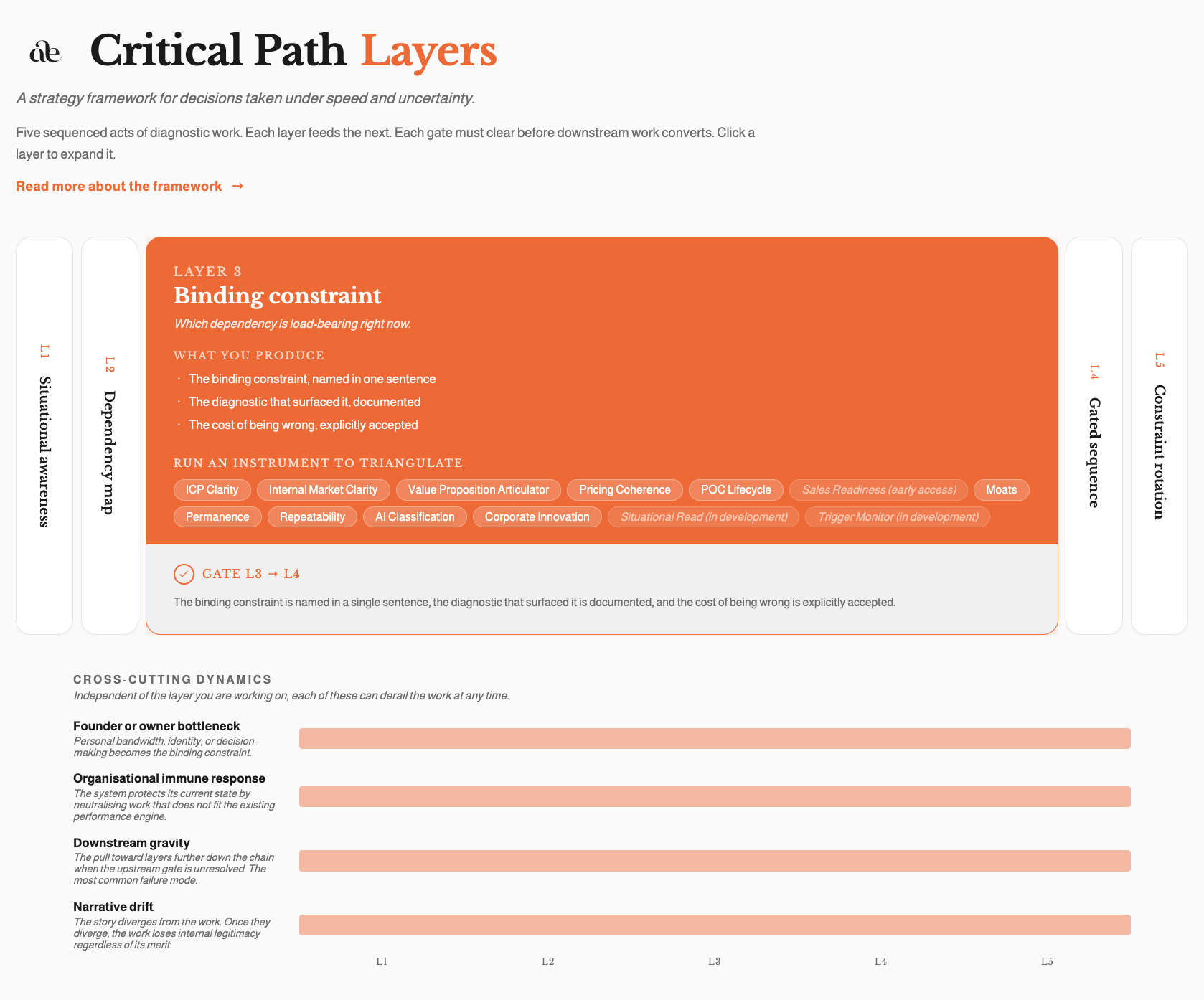
What Critical Path Layer is.
What it is, in one paragraph
Critical Path Layers, CPL, is a five-step diagnostic process for sequencing strategy when conditions are moving faster than the planning cycle. It is prescriptive on the order of work and silent on the content of the work. It tells you which dependency to resolve first, what evidence counts as resolved, and when to stop everything and re-read the terrain. The how of the work stays with you, your team, and your operators.
It is built on three commitments.
Dependency thinking, not domain thinking: a sales problem is rarely a sales problem.
Diagnostic before prescriptive: name the binding constraint before you spend the runway.
Gate-based, not milestone-based: a gate is a condition the work must clear; a milestone is a date someone wrote down last quarter.
What it is not
It is not a maturity model. It is not a transformation playbook. It does not tell you what to build, who to hire, or which vendor to pick. It will not give you a roadmap that survives contact with reality, because no framework can. What it does is give you a way of sequencing the next ninety days that is harder to fool yourself with.
Click on the image to access to Interactive Visualisation
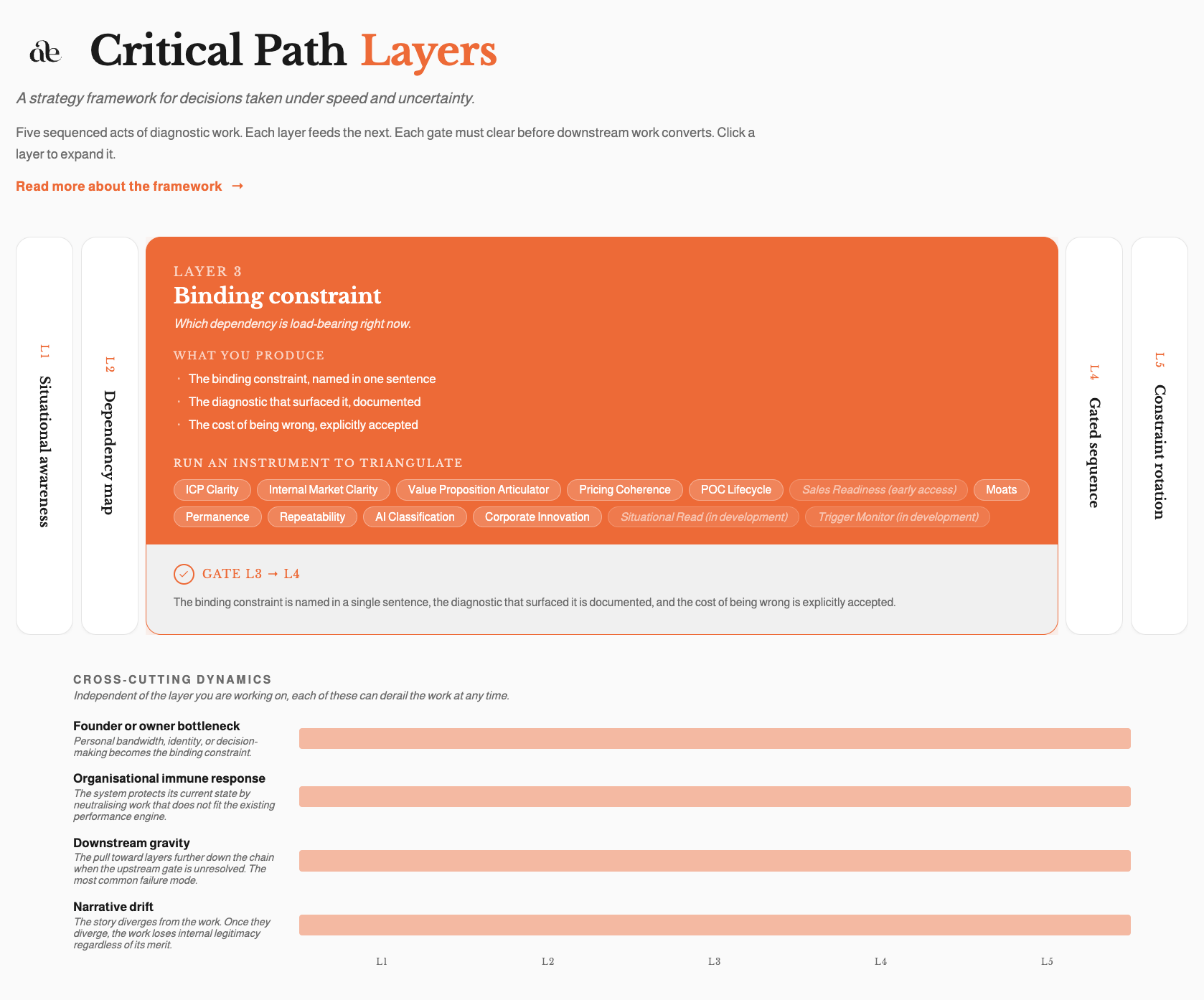
The 5 Layers
The five process layers
Read them as a sequence. Each layer depends on the one above it. Each layer has a gate. The gates are diagnostic, not administrative: the question is whether the work is genuinely resolved, not whether the date has passed.
Layer 1, Situational awareness
The terrain read. What has shifted in the last quarter, what is settling, where your inertia is, which dependencies you have not audited. You are not deciding anything yet. You are building a current map.
Gate: you can name three things that have changed since your last strategy review, the dependency each one breaks, and one assumption you used to hold that is no longer true.
Layer 2, Dependency map
The structural read. Given the terrain, what depends on what. Upstream layers, downstream layers, lateral dependencies. This is where domain thinking gets replaced by dependency thinking. A pilot conversion problem stops being a pilot problem and becomes a problem at the layer it actually sits in.
Gate: you can draw the dependency graph in fewer than twenty nodes, with directional arrows, and another competent operator can recognise what you have drawn.
Layer 3, Binding constraint
The diagnostic verdict. Of all the dependencies on the map, which one is load-bearing right now. Which gate, if not cleared, means downstream work will not convert regardless of how much energy goes into it.
This is the layer most strategy work skips. Most teams arrive with a hypothesis they have not tested; the work at Layer 3 is the test. Most of the diagnostic instruments on this site live here. You run several to triangulate.
Gate: the binding constraint is named in a single sentence, the diagnostic that surfaced it is documented, and the cost of being wrong is explicitly accepted.
Layer 4, Gated sequence
The sequencing decision. Given the binding constraint, what is the order of work that resolves it. What are the gate criteria for declaring each step done. What downstream work is paused until the upstream gate clears.
Gate: the sequence is named, each criterion is testable by someone who is not the operator, and the team has explicitly accepted that downstream work waits.
Layer 5, Constraint rotation
The movement detection. Strategy under speed and uncertainty is the recognition that the binding constraint does not stay put. The work at this layer is watching for the signal that your situational read has gone stale and a re-entry at Layer 1 is needed before the current sequence becomes wrong.
This is the layer most frameworks omit. It is what distinguishes a strategy operating system from a strategy exercise. Without it the whole stack ossifies.
Gate: the team holds a set of trigger conditions, each tied to a specific assumption from Layer 1, that when observed force a return to Layer 1. The conditions are written down. Someone is responsible for watching them.
Cross-cutting dynamics
Four dynamics that recur at every layer
Independent of which layer you are working on, four dynamics can derail the work. The framework names them so they can be diagnosed alongside the layer work, not after the damage.
Founder or owner bottleneck. Personal bandwidth, identity, or decision-making becomes the binding constraint.
Organisational immune response. The system protects its current state by neutralising work that does not fit the existing performance engine.
Downstream gravity. The pull toward layers further down the chain (sales, scale) when the upstream gate is unresolved. The most common failure mode.
Narrative drift. The story drifts from the work. Once they diverge, the work loses internal legitimacy regardless of its merit.
How to use it
Three reading tracks, depending on what you arrived with.
If you are placing yourself on the framework. Start at Layer 1. Ask the gate question for each layer until you find the first one you cannot answer. That is where the work sits.
If you already know your binding constraint candidate. Go straight to the instruments index. Run the one that tests your hypothesis. If it survives the diagnostic, you have a Layer 3 verdict and can move to Layer 4. If it does not, you have a more interesting problem than you thought.
If you want the intellectual provenance first. Read Critical Path Layers in the lineage of strategy. It places CPL alongside Wardley, McGrath, Reeves, Christensen, Snowden and others, and shows what CPL claims as its own distinctive contribution.
If you want to know where the framework came from. Read How I see, and why CPL has the shape it does. First-person. The cognitive origin.