

Corporate Track
For corporate innovation teams, the critical dependency that most frameworks miss is Layer -1: Innovation Intent.
Before any innovation work begins, the organisation's structural capacity to absorb the output must be assessed. An organisation that lacks a governance pathway from pilot to procurement will produce successful pilots that die in the transition. An organisation whose executive sponsorship is positional rather than substantive will generate innovation theatre that signals commitment without producing adoption.
The corporate track adds Layer -1 and reframes the remaining layers around internal adoption dynamics: the "buyer" is an internal adopter, the "value proposition" must account for adoption cost (effort, risk, political capital), and the "sales process" is an internal scaling mechanism.

The corporate equivalent of the founder bottleneck. At Layer 0, it manifests as mandate clarity — nobody owns the problem with sufficient authority. At Layer 2, it's pilot accountability: the innovation team runs the pilot, but nobody in the business unit is accountable for the result. At Layer 4, it's operational handover: the innovation team built it, but nobody in operations will maintain it.
Ownership Bottleneck

Originates at Layer -1, pervasive throughout, peaks at Layer 2 where the sponsor's political capital determines whether the pilot converts to a procurement decision or becomes a case study that goes nowhere.
Executive Sponsorship

The activators (regulatory pressure, competitive shifts, market changes) that created the innovation mandate can shift mid-programme, undermining layers that were previously resolved.
Strategic Alignment
Click on the image to access to Interactive Visualisation
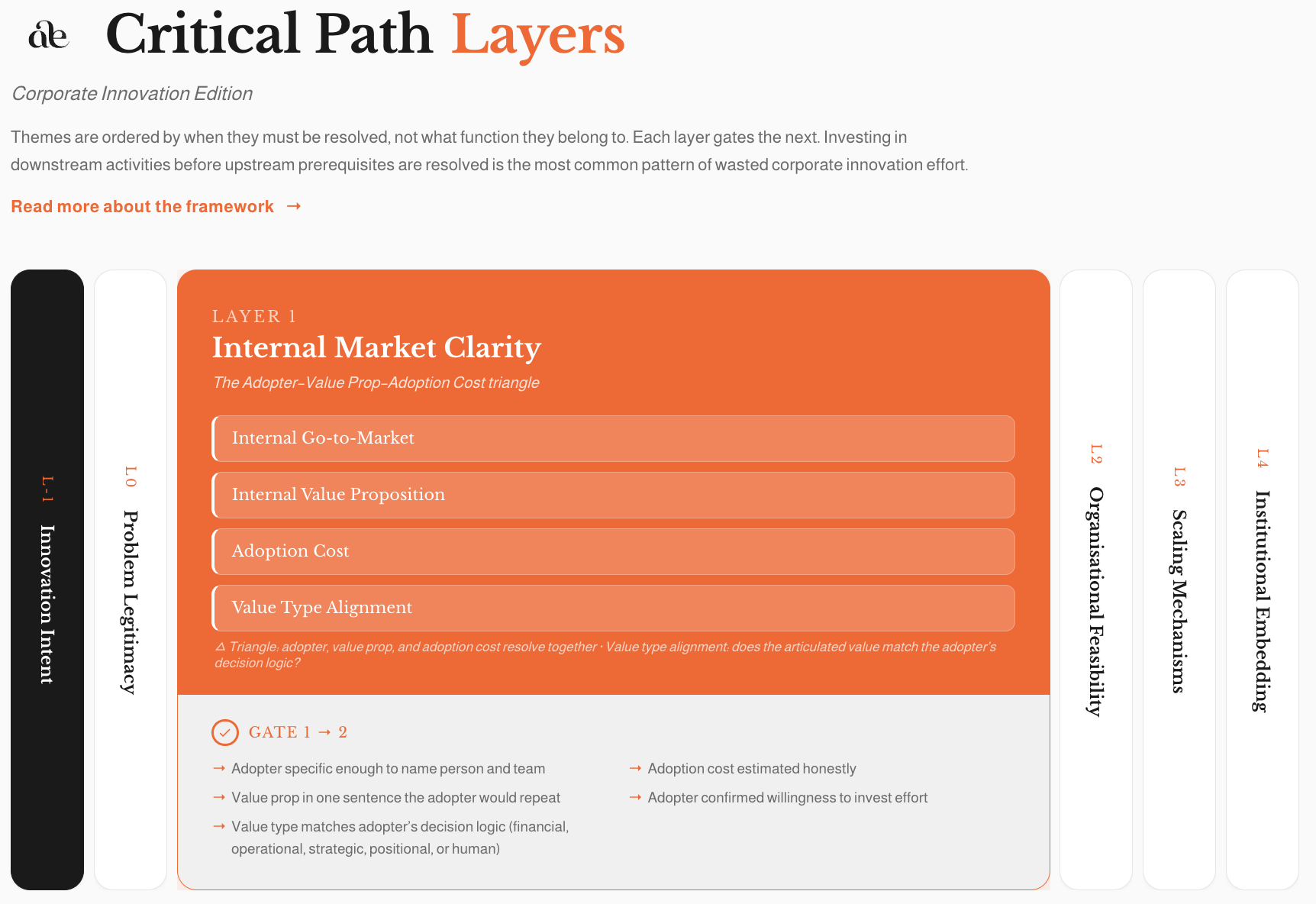
The corporate track also encompasses dynamics that don't sit in a single layer:
The organisational immune response. How large organisations neutralise innovation that threatens existing structures, budgets, or power distributions. Pilot results get reinterpreted, scope gets reduced to non-threatening levels, success criteria shift, timelines extend until the champion moves on.
Clock speed mismatch. The structural incompatibility between startup iteration cycles and corporate decision timelines. A startup that needs to validate in 8 weeks is selling into a corporate that makes procurement decisions in 18 months. No amount of product quality resolves this without governance redesign.
Innovation theatre. Programmes that produce the appearance of innovation commitment without the structural conditions for adoption. The test: does the programme have a governance pathway from pilot to procurement? If not, it is theatre, regardless of how well-designed the innovation process appears.
Cross-cutting dynamics

-
Recursive. Different manifestation at each layer: strategic clarity at the foundation, delegation at validation, systems design at scale. The bottleneck doesn't resolve permanently — it transforms as the organisation moves through the dependency structure.
-
Pervasive in accelerator contexts and corporate innovation. Peaks at Layer 2 (validation), where the engagement dynamic determines whether technical success converts to commercial or organisational adoption.
-
Foundational at the earliest layer, but strategic assumptions made early constrain every subsequent decision. When activators shift, previously resolved layers may need to be revisited. Strategy isn't a layer you pass through — it's a dependency that can be destabilised from outside.
POC Lifecycle as applied lens
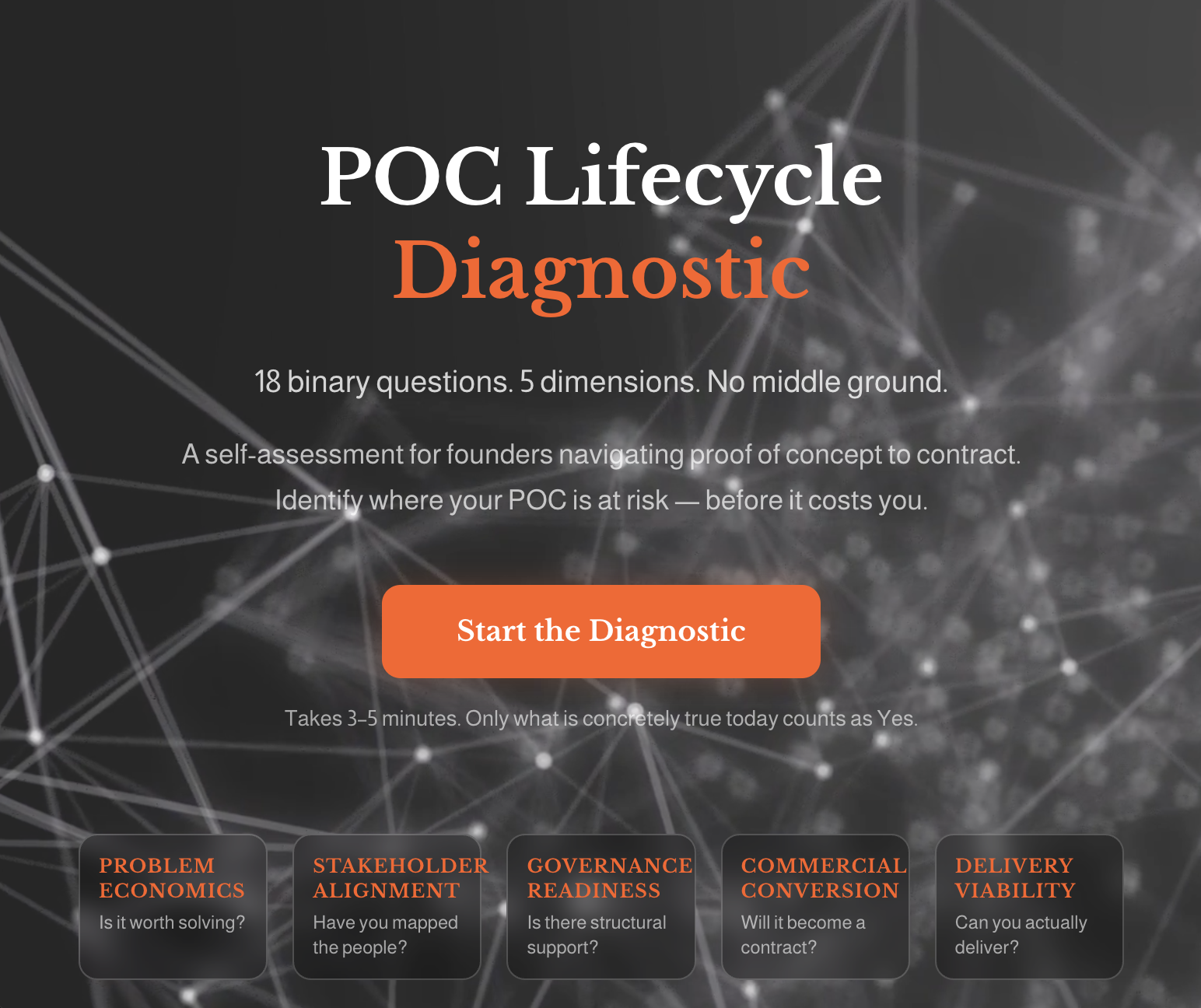
Click on the image to access to open the Diagnostic Webapp
The POC Lifecycle Diagnostic is the worked example that makes Critical Path Layers concrete. It maps the lifecycle of a proof-of-concept — from initial scoping through pilot execution to conversion — against the CPL dependency structure.
Most POCs fail not because the technology doesn't work, but because dependencies at lower layers were never resolved. The pilot hits every technical milestone but dies in procurement because nobody validated the governance pathway (Layer 2 → Layer -1 dependency). The results are strong but the champion can't make the internal argument because the value proposition was framed in innovation language rather than operational language (Layer 1 dependency). The pilot succeeds in one business unit but can't scale because the adoption playbook doesn't exist (Layer 3 dependency on Layer 2 resolution).
The diagnostic maps a specific POC against these dependencies and identifies where it's structurally stalling. It's free, and it produces a redirect recommendation: here is the layer where your POC is actually stuck, and here is what has to be resolved before the layers above it can hold.
→ Take the POC Lifecycle Diagnostic
→ Why your POC succeeded and still failed
→ Start a diagnostic conversation
→ Check additional resources
The layer assessment applies equally when evaluating companies from the outside — the dependency structure reveals where a venture is genuinely validated versus where it has built upward from an unresolved foundation.