

Startup & Scaleup Track
For founders and scaleup leaders, the most common misallocation is working on Layer 3 (commercial engine) before Layer 1 (market clarity) is resolved. The symptoms are familiar: a sales team that can't close because the ICP is too broad, a marketing spend that generates awareness without pipeline, a pitch deck that excites investors but doesn't match what buyers experience.
The CPL diagnostic for founders identifies which layer is the binding constraint.
In accelerator programmes (L'Oreal Beauty Tech Atelier, TotalEnergies ON, Bank of America, through HEC Incubateur), this becomes the backbone of coaching: each session starts by locating the founder on the CPL map and assessing whether the layer below is resolved.
The founder track applies Layers 0 through 4, with three cross-cutting dynamics that recur at every level:

The recursive pattern where the founder's personal bandwidth, decision-making, or identity becomes the binding constraint. At Layer 0, it's strategic clarity: the founder can't articulate the problem because they're too close to the solution. At Layer 2, it's delegation: the founder is the only person who can run the pilot. At Layer 4, it's letting go: the founder's operating style becomes the obstacle to the systems that would make the organisation scalable. Same dynamic, different manifestation at each layer.
Founder Bottleneck

Corporate Engagement
For B2B startups selling into large organisations, the corporate side of the dependency structure is ever-present. It peaks at Layer 2 (validation), where the startup discovers that the corporate's governance, procurement, and decision-making timelines create dependencies that no amount of product quality can override.

Foundational at Layer 0, recurrent throughout. Strategic decisions made at Layer 0 constrain what's possible at every subsequent layer. When the strategy is wrong, effort at higher layers compounds the original error.
→ Read about the Layer 3 trap (article forthcoming)
→ Why your POC succeeded and still failed
Strategy
Click on the image to access to Interactive Visualisation
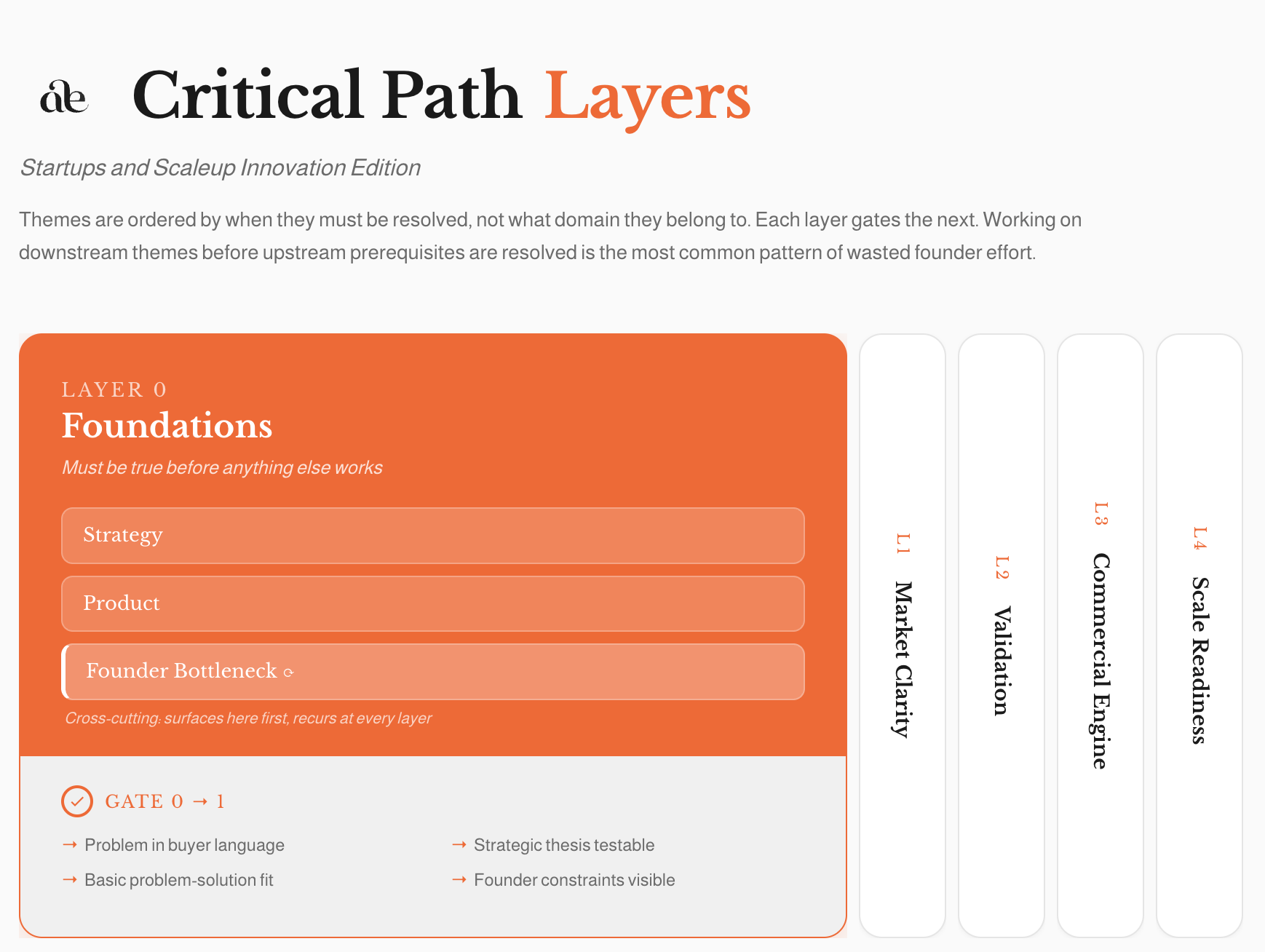
The layers:
Startup & Scaleup Track
Layer 0: Foundations — Must be true before anything else works. The preconditions: a problem stated in buyer language, basic problem-solution fit, a strategic thesis that can be tested, and visibility into founder constraints. Gate criteria: if you can't articulate the problem in one sentence a buyer would recognise, you haven't passed Layer 0.
Layer 1: Market Clarity — The ICP-Value Prop-Price triangle. Three things that resolve together, not sequentially: who specifically you're selling to, what value you deliver in their language, and what they'll pay. Gate criteria: ICP specific enough to name accounts. Value proposition in one buyer sentence. Willingness-to-pay evidence, not assumption.
Layer 2: Validation — Prove it in a real corporate context. Corporate engagement intelligence, technology integration feasibility, and pilot execution — in that order. Gate criteria: pilot completed with success criteria defined by the buyer, not the seller. Results packaged for the champion's internal argument. Governance pathway mapped.
Layer 3: Commercial Engine — Build repeatable demand, only after validation. Sales process, marketing tied to pipeline, brand credibility. Gate criteria: repeatable sales motion, documented and transferable. Revenue growing with plausible unit economics.
Layer 4: Scale Readiness — Systematise what works, not what you hope will work. Operations, team, financial management, and fundraising (conditional — only after commercial engine is proven). No gate criteria listed: this is the layer where the dependency structure gives way to operational execution.
Cross-cutting dynamics

-
Recursive. Different manifestation at each layer: strategic clarity at the foundation, delegation at validation, systems design at scale. The bottleneck doesn't resolve permanently — it transforms as the organisation moves through the dependency structure.
-
Pervasive in accelerator contexts and corporate innovation. Peaks at Layer 2 (validation), where the engagement dynamic determines whether technical success converts to commercial or organisational adoption.
-
Foundational at the earliest layer, but strategic assumptions made early constrain every subsequent decision. When activators shift, previously resolved layers may need to be revisited. Strategy isn't a layer you pass through — it's a dependency that can be destabilised from outside.